+

The Villain

What is it about the villain that’s so great? Why do we like villains so much… to the point where we want to see the villain more than the hero?

Well originally, villains were just supposed to be a plot device. A simple element that was used to create a plot. There was no rhyme or reason to it. The villain was just a bad guy, there was very little back story or justification for it.

Over time, that changed. With crimes like those of Ted Bundy, Manson, and the Son of Sam killings, people started to become more interested in what made a villain tick. What made the Joker become the person with the white makeup? Why did the mad scientists and engineers that Superman fought do what they did? We established they that they were bad guy, but we never established why.

That’s when we started getting villains like Darth Vader, a tortured soul who became evil over years of conditioning and crippling fear of losing the ones he cared for most.
Other great villains would then follow. Suddenly stories were full of villains who were tortured during childhood, villains who were pushed into their crimes by their circumstances, villains who initially good guys but were betrayed by the actual good guys. Often, villains are villains because of a point of view. Many villains could actually be good guys if the narrator hadn’t already established who the ‘good guy’ was.

My personal favorites are the villains that are the most like the heroes, that want the same thing as the heroes but have different methods for achieving their goals. The X-Men have perfected this with Magneto. Some would call this the Anti-villain.

So why do we like these villains? Well I believe their story makes them more relateble, harder to hate because many people could see themselves become like them should the circumstances be right. How many could not see themselves coming to the same life conclusions as Magneto after living through such horror, only to see humanity make the same mistakes over and over again?

So does that mean that the plot device, static, villain no longer has a place? Well… to a point. If a story doesn’t have room for a largely dynamic villain in a story with multiple good guys and he’s just the device to bring them all together or influence their lives, then yes, a static villain has a place, but those types of villains are becoming rarer and rarer and eventually may go away. A good example of this type of villain still being used would be Lord of the Rings. Think about it, what is Sauron’s motivation for what he’s doing? Is that ever established in the move?

+

Can fictional stories be harmful?

Unfortunately, I have to say yes… hesitantly.

Fictional stories can absolutely be harmful if taken the wrong way or interpreted incorrectly.

A good example would be many of the Bible stories. The Bible was a good written by man for man. I can’t speak to who wrote the old testaments or how, but the new testament, at least as far as the Gospels are concerned, were written for different groups of people. This is why there are noticeably different from one another.

Is there historical truth in them? I’m sure there is, to a point. Like there was historical truth in Homer’s Iliad.  We know that Troy existed, we know that there was a war that destroyed the city, but were there Gods and immortals fighting there? Unlikely…

The Bible is similar in that while I do believe that Jesus existed as any good Christians do, I believe that he was crucified, and I believe that he rose from the grave, some of the stories may have been exaggerated or made up for the purposes of creating parables or lessons for people to live by. Keeping in mind that all of the canonical gospels were written well after the death of Christ and far beyond the life expectancy of his Apostles.

Yet knowing this, how many have been killed because of these stories? How many wars have been fought?
(Again, this is my personal opinion, I know that there are those out there who interpret the Bible as historical fact and I am well aware that I could be wrong.)

Another good example are the fairy tales that we know and love. Disney is a good example of this as they have recently been taking flak for altering the original stories and watering them down (Removing the Little Mermaid’s suicide, removing the part about Cinderella’s sisters  cutting their toes off… and don’t even get me started on Frozen…)

How do these harm us? Well…

For starters, I don’t believe in love at first sight and I don’t know very many people who do. Now you can call me glass half empty kind of guy, and maybe I am, but I prefer the term realist. Some of these stories paint a dangerous picture of how relationships are supposed to go. For one, painting women as an unequal part of the relationship, the damsel in distress, and the guy always being the one to save her is especially worrisome, and I’d like to illustrate why.

Guys and girls, we all suffer from a complex, more so than most of the previous generations, that may stem from some of these stories.

We here in the news all the time about a girl getting beaten by a guy, or fleeing for her life, and battered women shelters being overcrowded. Many people ask how they get themselves into those situations. Why do they go back to an abusive spouse or boyfriend. Why do they even give that guy the time of day to begin with?
Well, there are many reasons, most of them psychological, but also conditions like children or not being financially stable, but let’s focus on psychological for a moment.
In most cases, at least in my experience from the friends that I’ve had, the idea that he really is a good guy if you get to know him, or the idea that the woman thinks she can change the guy, or he wasn’t always like this, comes up a lot.

Most of the time when it comes to this, the girl sticks with him because she sees something there deep down that if she can bring out, will make the guy an upstanding person. The ability to see something in someone or something that no one else sees is a wonderful gift, but it can also be a very dangerous one at that. The reality is that most people can’t be changed, even if they want to. Nature is a hard adversary to combat.

This is one of those areas that some… albeit less thoughtful people will say that the woman brought it on themselves that they should have known better. Well maybe, if they saw it at the beginning, then they should have run the other way and quickly. However, if they didn’t see it, then it’s a lot harder to get out of once you’re already knee-deep or beyond. Again, the fairy tale goggles come into play here too in that they may see the man inside the beast. (Beauty and the Beast Reference.)

Guys, we are not immune to this. We’re not. Where women go for the bad boy in order to try and change him… we do the same thing, but in a different way.
Many girls, even if they don’t realize it see themselves as Bell and that guy as the beast.  Guys, we see ourselves as Prince Charming. Laugh all you want, whether you realize it or not, it’s true. Where girls go for the asshole, guys go for the… for lack of a better term, the girl who has been damaged in some way.

It’s always the same story over and over, a guy meets a girl, get’s to know her, finds out that she has either a troubled past, cruel or abusive parents, or some psychological issues. Does that make us go running? Should it? Well that depends. Unfortunately for many guys, on some level, we see ourselves as the hero who is going to be the turning point in that person’s life and we start trying to build said person up and try to restore confidence, break the hold a bad parent has over them, or try to help them overcome a psychological issue. The result in too many cases is that the guy who is trying to be the hero, the guy who is trying to help, eventually in the eyes of the girl, becomes part of the problem. The end result is that the girl takes the new-found confidence or strength and using it against the very person who tried to help. Thus pushing that person away and sending the girl back to the downward spiral such as the abusive party that they were trying to break free of.
In the end, you’ve got the opposite of the desired effect, and both parties comes away damaged.

Now, does this mean that the damaged girl or the bad boy are unworthy of compassion and love? No, absolutely not. What it means is that the person who chooses to be with them can not try to change them. Help them, but don’t push them into it. Accept them as they are and go from there. It’s unfortunate, but it is the reality. You can’t change a guy and Prince Charming doesn’t exist.

So that’s it, now are fairy tales 100% to blame for this? No of course not, nature, nurture, and… yeah in some cases, stupidity also play an affect, but that doesn’t mean that the stories we tell our children shouldn’t be examined en mas to see what kind of damage that they could be doing.

Anyway, leave a comment, let me know if you think I’m right or if I’m way off!

Catch you on the flip side!

-Jim

+

Question: Did Mithrandir (Gandalf) and Galadriel have a relationship at one point?

In my opinion… YES!

Though there really isn’t any evidence of it in any of the books. The movies make it more than apparent.

There is no doubt about it. It’s not really apparent in Lord of the Rings although the look on Galadriel’s face is of concern when she discovers that Gandalf has fallen.

Not only that, but the way they react to each other during the White Council (especially when he first sees her) is even more evidence.

But really, the only proof I needed is this video:

Now, is it possible that I’m thinking too much into this? Yes.
Could they have just been really close friends? Absolutely, but I don’t buy it.

Let me know what you think. Am I right or wrong?

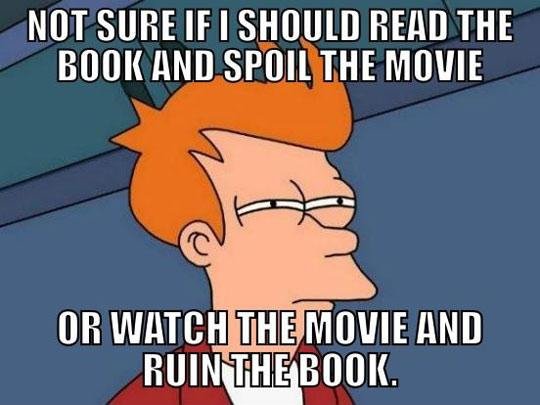
Does a book becoming a movie ruin the book?

The answer SHOULD BE a resounding NO!

If Magnifica or Divinity were ever made into a movie and it stunk… my book would still be sitting on the shelf, available to read. The movie will have done nothing to it.

That said, if a book was turned into a movie and the movie turned out to be better than the book (happens, though rarely), then it  could lead to disappointment in the story.

+

Do Facebook and Goodreads ads work for self-publishing authors?

Nothing but the truth!

Jen Bresnick's avatarJennifer bresnick.com

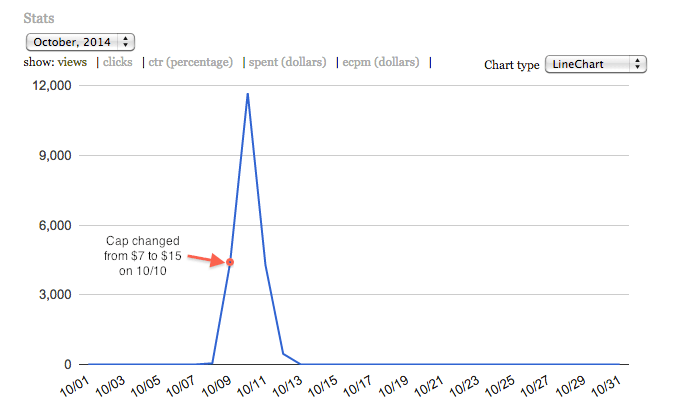
Web ads. Ugh. Flashy, annoying pop-ups and distracting sidebars; exhortations for products you don’t really care about; “targeted” pitches for lard clarifiers and chimney collars and one weird trick that will extend your life indefinitely in exchange for your first-born child. We all kind of hate online advertising, and yet internet ad revenues have reached $11.6 billion in the first quarter of 2014, according to one report. Eleven billion dollars. Eleven. Billion. So I guess someone must be clicking on them, right?

With the launch of Dark the Night Descending, I wanted to see if maybe I could expand my audience beyond the current reach of my small (read: tiny) social media presence. I chose three different publicity methods: Facebook newsfeed ads, Goodread sidebar ads, and a Goodreads book giveway. I’m here to report on my results and answer that burning question: is it worth paying for advertisements?…

View original post 981 more words

+

Character development progression…

Not all characters come from the same place. Not all are based on a person we know and not all are created directly from our minds. Some characters are taken from bits and pieces of other characters, perhaps a personality trait, internal demon, or other factor is taken from a third party source and incorporated into a brand new character.

In a previous post, I mentioned Lia’na. Part of her personality and reactions to certain situations came from my life… some, but not all. The rest was just my own original creation.

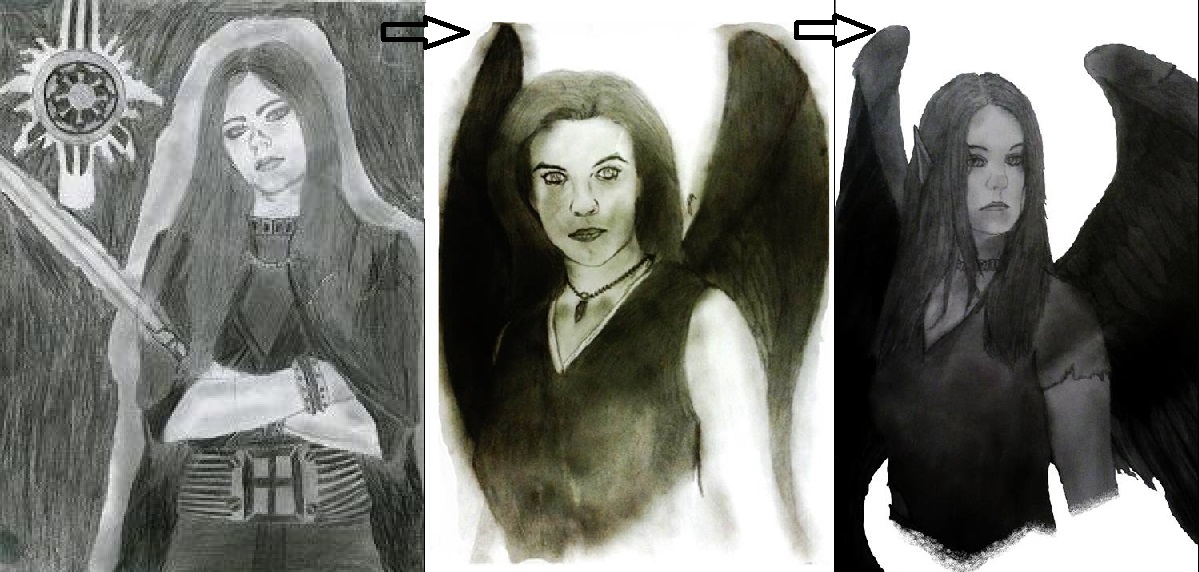
The above image is a character that I’ve written into one of my other stories… or perhaps a couple of different stories. From left to right; Darth Malyse, Xaphan rough, and Xaphan final. I created these concept images as I worked. I’m using this as an example of how I drew upon an old character that I created to make a new one.

The first character, Darth Malyse, was a character that I created for my friends’ Star Wars RPG. She was a young woman who was once a Jedi Padawan, but became disillusioned with the Jedi order. No one knows where she came from or who her parents were. All they knew was that she was a force sensitive and a particularly powerful one.
She was forbidden from learning about the dark arts, though she viewed the teaching as essential in order for Jedi to be able to defend themselves against the darkness, and on her first mission away from the Yavin Academy, she falls to the dark side and murders someone.

Malyse Personality:
She is young and angry. Her abilities and dark tendencies made her stand out and earned her the scorn of almost everyone at the Jedi Academy. She is extremely powerful, but has a tenuous hold on her emotions. The result is that she often is unable to control her powers. She despises most Jedi and views that as imperfect impostors of the what the Jedi order was during the days of the Old Republic. Her one weakness is her friend, her only friend from the academy, Thaidani. Circumstances force her into facing him down. She is far more powerful and easily defeats him, but each time, she finds herself unable to kill him. She finds herself constantly fighting between the darkness and the light. It’s a struggle that would eventually culminate into one final showdown where she has to choose a side and her decision could result in the death of Thaidani.

This was one of the more dynamic characters that I’ve ever created. She was everything I wanted in a villain, but I knew that her story could never see the light of day in published form for 2 reasons;
1. I couldn’t afford the Lucasarts royalties.
2. My story fell outside of what was considered ‘canon.’

So I abandoned her all together.

I admit that this haunted me for a while. I wanted to use this character in some form and eventually came up with Xaphan. I borrowed some information on this demon from an earlier religious source that dealt with the Celestial Wars in Heaven when writing one of my stories and then built a dark angel, borrowing nearly everything from Xaphan. So now she was a youthful angel that didn’t have control over her abilities… but that didn’t make much sense for this story.

So eventually she turned from being a young angel with no control to a more matured one who had control, but was very powerful and very wise… then it went back to her seeming youthful, but still brilliant… needless to say, I went back and forth a few times.

The end result:
Xaphan – 
A skilled military leader and tactician in the army of the Most High (God). She faced off against Saint Michael and almost won. She is angry and extremely arrogant. She functions under a code of honor, but still sided with Lucifer. Her only weakness is a human soldier that she met during her time on Earth.

As you can see, some of the elements are still there, but much has been changed from the original.

Good Writer =/= Good Reader?

Is being a good reader required to be a good writer?
Surprisingly no. You do not need to be good at reading to be a good writing. Some of the most famous writings were the work of people who were literate and passed their stories down through orally. Homer, the author of the Iliad and the Odyssey, is considered by many to have been blind.
This is part of the reason that most states require both a reading/comprehension and a writing course for teacher licensure. They are two different things.

Now does being a good reader help? Well it certainly doesn’t hurt. Being well read gives you the advantage of having several sources to draw from when it comes to organizing your ideas. If you’ve read multiple books, chances are, you know how to write and organize your thoughts in a way that works, because you’ve seen it done before, many times.
Another advantage is that you’re most likely a lot more learned when it comes to spell, grammar, punctuation, and paragraph creation. This part is a source of contention however. Many would say that this is the job for an editor.

I can understand both sides of this argument, but I would make the case that while, yes it is an editor’s job to weed out spelling, grammar, and potential continuity errors, editors are human, just like the writer. They can make mistakes and they can miss something. This is true even if you have more than one person edit your writing. Case and point: The less mistakes you make, the less chance there is that the editor will miss something.

How is it not necessary though?
Well think of it this way, can an illiterate person sit down and tell a child a riveting story that he or she had heard from their parent? Can they organize their thoughts and use their imagination? Yes! However, they would need someone to write the story down for them. Now this is an extreme example, but it goes to the point that being able to write and tell a story doesn’t necessarily go hand in hand with reading well.

Writing Hovels and Fairies

A new story of fairies from a talented writer. Give their page a look!

edmondevereux's avatarMusings Of An Englishman

fairyfairy photo credit: CapCat Ragu via photopincc

I’ve been very inconsistent with blogging, which is the result of my mind being in a flurry over the fairy story that I’ve been writing. This is a first for me (a fairy story, not going into a little hovel for days on end as I focused on writing) and I finally decided that I wanted to post a small piece of the story. Nothing very big yet. I don’t believe in sharing too much of a story before it’s written, as I can lose inspiration very quickly if that’s done.

Admittedly, this is a very rough draft. I’ve written it in the form of a role play, using present tense and mostly dialogue. No decent description has been added, but I’m not concerned about that right now as I shall work all that out later. My main goal has been to get heart…

View original post 545 more words

Plot Contrivance – Character Balance Rule.

Simply put, whenever a character dies or is killed off, usually they need to be replaced. There is rarely a gap. Either a mentor is replaced by a comforting friend, or a family member is replaced by a lover, or a future disciple. While the replacing character doesn’t usually take on the role of the previous person, they are intended to fill the void. The purpose of this character is usually either a replacement sage, a new direction for the main character’s feelings, or just to keep the number of main characters up in some cases.

You especially see this in people who suffer from the Obi Wan Kenobi complex (See Character Complexes):
Examples:

Obi Wan Kenobi (DUH!) – You could make the case that he is replaced in Episode 4 either by Princess Leia or Han Solo.

In the Terminator series, Sarah Connor would be rather egregiously replaced by the red-head who plays John’s wife.

… Pretty much every Rocky Mentor: Mickey> Apollo> Duke, and then Rocky’s voice of reason was replaced Adrian> Robert.

In LOTR Gandalf the White replaces Gandalf the Gray… I know, I know, same person, but there are differences between the two characters. Read the book for more info on this.

In the Lion King Mufasa is replaced by Pumba and Timone.

In Bambi, his mother is replaced by… well his father.

Heck even I unintentionally did it a lot in the story I’ve been working on… a couple times in fact! Father Antonelli> Nicolas/Gregory> Federico> Adaline.

Now are their stories out there which do not do this? Sure, most horror and thrillers just kill people off left and right and usually do not refill the empty slot. On occasion you may see a best friend replaced with a love interest or something of that nature, but it’s rare. It also seems like that besides the horror movie exception, few movies can get away from this plot contrivance without losing a lot along the way. Few movies actually come to mind that were any good after killing off a main cast member and not replacing him/her.
So what is it about our stories and our movies that makes such a plot contrivance necessary? Why do we feel the need to build up a character, make others feel strongly (either like or hate) and then kill them off simply to replace them with someone else in the name of furthering the plot? I’m not complaining by any stretch as, obviously, I am admittedly guilty of the same thing, but I don’t know why it’s an almost constantly recurring device.

+

Dean Koontz Strange Highways (Short Story)

As indicated in a previous post of mine, Strange Highways is a story that I hold very close to my heart. At only 154 pages long and an easy read, it’s amazing how much this few-hour-read draws you in and keeps you in.

Renown thriller writing Dean Koontz really hit it out of the park with this one.
Synopsis (pulled from Wiki):  A failed author returns to his hometown after many years to attend his father’s funeral, only to find himself suddenly and inexplicably thrust back through time to relive a traumatic event from his past, and possibly to find redemption. In the introduction, Koontz lists the Centralia, Pennsylvania mine fire as an inspiration for this story.

I first read this story back in 1999. My High School’s summer reading list allowed us to choose 5 novels and my father just happened to own this one. Being someone who loved thriller movies, I decided to give this a whirl, heck it couldn’t be any worse than ‘When Legends Die’ off of the previous years reading list… right?

Famous last words aside, at first, this book seemed reminiscent of the average Stephen King novel. A failed, alcoholic writer who was down on his luck. The first few chapters are depressing and dreary, but the erratic behavior of the lead character keeps you hooked just enough to want to find out what pushes him to behave the way he does. The payoff is well worth the wait.

As the rain begins to fall after the main character, Joey’s final farewell to his father, the action picks up. The man is given the opportunity to re-live a pivotal moment in his life. He has to choose between taking the road he took before, which is a safe, but petty and insignificant existence, or take the road he had decided to avoid years ago that would lead him into danger. If he goes down that path, Joey will have to confront someone close to him that is nothing short of true evil and save an innocent and pleasantly mysterious character.

I will stop right there as I really don’t want to give too much away. So I will give the pros and cons of this story.

Pros: The story hooks you within the first few pages. It is short, but action packed. There are several moments in the story that make the hair stand up on the back of your neck. The imagery and the sense of urgency is well done. The main character is relatable and the heroine is mysterious to a level that you never know where she stands or what her motivations are until the very end. You feel like you have to keep an eye on her throughout most of the read. The ending is very well done, ties everything together and is extremely satisfying.

Cons: There is a supernatural element to this story that is never fully fleshed out or explained. You find out why Joey is given a second chance and why he is the way he is. However, while it’s alluded that the supernatural element is religious in origin, it is never explained and really has the feel of a… for complete lack of a better term Deus Ex Machina.

Overall Analysis: I love this story. It is my favorite of all time and that is saying a lot. It’s short, but well-paced and very well done. It has one of two major flaws, but they add some mystery to the story and do not detract from it at all. Truly a wonderful read for those who like action/fantasy/religious philosophy/thriller.

My hat goes off to Dean Koontz on this one.

+

The Miserable Slayer

A very well written piece from a talented author, give it a whirl and see what else their page has to offer!

+

Character Interview: Magnifica, Lia’na of the White Water Clan.

Host: Hello and welcome. Today we have a very special guest from the new and exciting story called Magnifica. Please join me in welcoming the heroine, Lia’na of the White Water Clan.

Lia’na: Lien ni, it’s wonderful to be here.

Host: So Lia’na how are you today?

Lia’na: Very well, lien ni!

Host: Now I’m curious, what exactly does lien ni mean? Is that thank you in Elvish?

Lia’na: Yes, that’s correct.

Host: Ah see, you learn something new every day. So Lia’na, tell us a little bit about yourself.

Lia’na: (brushes her hair back behind her pointed ears) Well as you can see, I’m an elf. I come from the White Water Clan which lives on a small reservation up in New Hampshire. There are about 20 of us all together.

Host: Only 20? Why so few?

Lia’na: Well unfortunately my people have been ravaged by disease for several thousands of years. Our numbers have dwindled down to less than a thousand. As a result, our clans are scattered all over the planet, but the numbers in each clan our few. Even the number of clans has dwindled over the years. The Black Rock Clan, the Ice Wind Clan, among others have ceased to exist in the last two decades.

Host: So your people are dying of disease? Including you?

Lia’na: Thankfully not anymore. My people saw the extinction of our race coming and following the discovery of our race’s existence around the time your second World War took place, we decided to come forward and ask for help from humanity. Your kind had become advanced in the ways of medicine and science. In exchange for your help… we gave your people historical texts and artifacts that dated back over 15,000 years prior to your earliest recorded history. That turned out to be a mistake.

Host: Why?

Lia’na: To understand that, I’m going to need to go back a little bit. You see, there was a time when elves, dwarves, and humans lived in harmony in a society now commonly referred to as the Alliance. Our technological achievements equaled those of Ancient Rome… the major difference was the presence of magic.

Host: So what like witches and wizards?

Lia’na: Sort of… we referred to them as enchanters. Only humans were able to possess such power. The abilities came from an unusual gem called the Lux Mundi. It was a large monolith, rumored to be solid diamond that was orange in color. Latest historical analysis indicates that the diamond came to Earth from the asteroid belt, following years of being exposed to the Sun’s radiation. We can’t explain what happened, but the atomic makeup of the diamond in addition to it’s radioactive nature altered the genetic makeup of certain people with the right traits and brain functions, giving them supernatural abilities.

Host: What happened to them?

Lia’na: Well, there’s truth to the saying that absolute power corrupts, absolutely. Only one of every thousand children were born with the gift. Those that were, viewed themselves as superior… especially since the genetic makeup of elves somehow negated the Lux Mundi’s abilities. Elves were not able to become enchanters and our mere presence near the crystal seemed to damage it. Wars for superiority began to tear the Alliance apart. The dwarves were the first to discover the Lux Mundi and viewed it as a holy relic. They built a shrine to it on the crash site, which is now known as Mount Vesuvius. Thousands were slaughtered over control of the diamond. The Elven elders at the time came forward and preached against the fighting. Those that were not killed, called on all Elves to break ranks with the Alliance. A group of several thousand marched on Vesuvius and went before the diamond. Several of them willingly sacrificed themselves and used their blood to break down the diamond.

Host: Your blood?

Lia’na: Elven blood is far more acidic than humans’ is. The plus the fact that we seemed to negate it’s abilities, made us likely candidates to destroy it. The crystal collapsed into several small pieces which became extremely hot and sank deep into the Earth. We don’t know how, but the result was a massive explosion that turned a small hill into the Mountain that we now know as Vesuvius. It’s said that only a fraction of the elves who went after the Lux Mundi survived. Not long after, our people began exhibiting unusual symptoms and an illness on our skin. Our people tried to isolate the people who had the disease, but they failed and it spread like wildfire through our people.

Host: So that’s why there are so few of you left.

Lia’na: That’s right. Because we didn’t know if humans or dwarves could be infected, inter-species mating was forbidden. The dwarves viewed the destruction of the Lux Mundi as an offense to God and ended their participation in the Alliance. They broke off into several groups and burrowed deep underground in search of the remains of the Lux Mundi. They burrowed so far down into the Earth that there would be no contact with humans for many thousands of years. Our people, fearing what would happen as the result of this and wanting to tend to our own, fled the Alliance and hid in the most remote corners of the world, leaving humans to essentially start over. Your people broke off into tribes and spent thousands of years fighting among yourselves. Almost all knowledge of the Alliance was lost to the sands of time for humans and you began to rebuild. It wasn’t until ancient Sumeria that your people actually started organizing into societies again. Giving humans knowledge of these events opened the door to racial bigotry and blind hatred of our people. Many viewed us as the reason that the world is in it’s current state, like we were the cause of every bad thing that happened on the planet.

Host: But some good came of it.

Lia’na: Yes, thankfully the more educated of your people deemed us a protected and endangered species and worked diligently to find us a cure. They failed to do so, but managed to come up with a vaccine that would prevent the disease from being passed from mother to child.

Host: Ah, so your race was saved.

Lia’na: Not quite… the damage from the disease that we called the Ulium was done. It damaged our genetic makeup to the point where procreation became difficult. Only one in five Elven children are born female. That is why our numbers continue to dwindle. The result of this means that now, the moment a female is born, she is immediately betrothed to a male mate which she must then marry at 18. She has no say in the matter.

Host: She can’t say no?

Lia’na: In a way, she could. If she has a friend or another male that she finds more suitable willing to fight for her, then she can ask him to issue a challenge. If that challenger wins, betrothal rights fall to him, at which point he can choose to keep them or release her.

Host: That doesn’t really sound fair.

Lia’na: It’s not… and I don’t really care for the person whom I’ve been betrothed to. I petitioned the Elder Elven Council for permission to postpone my marriage because I wanted to go to college. I wanted to study medicine and try to fix the genetic damage done to our gene pool. The elders agreed, not knowing that I had no intention of going to the Elven University in Holland.

Host: Why not?

Lia’na: I wanted to get out and see the world. I wanted to get to know people and see things beyond my clan’s land.

Host: How did that work out for you?

Lia’na: My clan’s elder, Masarabi nearly threw a fit when I told her that I was leaving. She said that people would despise me and treat me like an outcast… I’m sorry to say that she was right. I originally went to a school in the central part of the United States, after getting a government scholarship that amounted to a free ride. I spent much of my time hiding in my room out of fear. Eventually, I transferred up to Arcanus in Boston. I figured that, given the state’s history of being more progressive, I’d be more welcomed and it was closer to my reservation in New Hampshire.

Host: Was that any better for you?

Lia’na: So far… not really… I mean people aren’t as vocal about their personal biases, but they give me a wide birth for the most part. I spend a lot of time alone.

Host: I’m very sorry to hear that, I sincerely hope it gets better for you. Not all people are like that.

Lia’na: Oh I know, I’ve met a few good ones over time.

Host: So I noticed the gem you’re wearing. That’s very ornate, is it Elven-made?

Lia’na: Lien ni. It’s an artifact that has been passed down my family from woman to woman. It’s rumored that the orange gem is a piece of the original Lux Mundi.

Host: That’s… extraordinary. It’s a wonder it’s not in a museum or something.

Lia’na: The Elven people keep our artifacts close… and it’s just a rumor anyway, there is no real way to confirm it.

Host: What would happen if it came into contact with someone who met the right genetic makeup?

Lia’na: I suppose that it would give that person the powers of the enchanter, but it’s such a small piece and it’s been around humans before without something like that happening. Like I said, it’s probably not even real, but it’s all I have of my mother.

Host: Oh I’m sorry, your mother is no longer with us?

Lia’na: No… and neither is my father. They both died shortly after I was born. They were two of the last victims of the Ulium.

Host: So what are you up to now, what are your plans for the future?

Lia’na: Well I’m working on becoming a doctor as I said before. My major is premed with a focus on genetics and it’s my hope that once I graduate, I’ll be able to get out of this arranged marriage sham and work for the betterment of my people.

Host: And we wish you the best of luck. Thank you for joining us today.

Lia’na: Lien ni for having me!