by Jim

It’s said that if you bend but one shade of grass, you run the risk of altering history…
I see a lot of stories, shows, and movies dealing in time travel, how it ‘works’ and the consequences of using it. I usually try not to write about it in my stories for a few reasons… One, time travel is a headache to figure out. When you try to get into the ideas of time theory, temporal physics, and paradoxes… You could spend years just trying to get that right… and still fail miserably. Let’s go through some of the established theories we’ve seen in science fiction and try to dissect why they may or may not work.
Keeping in mind, these are my own theories based on my understanding of physics and logic… so please don’t think that I’m trying to state anything as scientific fact, I’m admittedly not an expert. If we any physicists here, please feel free to speak up! I’d love some insights.
Theory 1: Destructive Paradoxes and “force infinity time quakes”
I’ve seen this theory pop up a few times, but the first place I saw it was in the not-so-well-liked movie Millennium (1989).
The theory stands that if you travel through time and create an irreconcilable paradox, time itself will rip apart at the point in time most affected by it. However future and past areas are not affected.
Essentially “If you build a time machine to go back and kill Hitler and successfully pull it off, then you have no reason to build a time machine in the future and if you had no reason to build it, then Hitler would come to power… so what happens?”
Honestly, I shake my head at this one. I can’t honestly believe that the universe would be that poorly run that it could so easily destroy itself. Plus this goes against pretty much every other time travel theory out there. However the cyclical question is an interesting one to cover, so we’ll revisit it in another theory.
Theory 2: Non-Linear Time
The next theory is one that, again I do not subscribe to, but is interesting. Back to the Future covered this one in some detail. In essence, time isn’t a straight line at all and has to be looked at 4th dimensionally. Once time travel takes place, the flow of time follows the travelers, in essence, the stream of time looks a lot more like this:
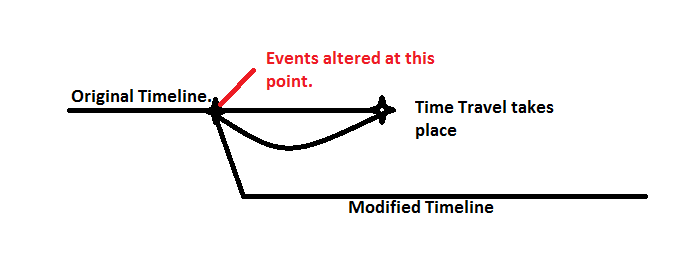
Essentially any future events cease to exist the moment time travel takes place and are replaced with whatever changes the traveler makes. Now this of course calls into question how time works with multiple travelers… one can imagine that this diagram would look a lot more messy and would also call into question how multiple changes would be calculated out. Terminator also sort of touches on this one… but… let’s not get into the Terminator timeline, that’s another post in and of itself.
Theory 3: Fluidic Time
This is a theory that a close friend wrote in a middle school paper. In essence time is likened to a strong river. If you throw a stone in it, you can divert its course, but it will make its way back to its original path naturally. To back to the Hitler theory, if you go back in time and kill Hitler, one of his subordinates would take over and while certain events would be altered, time would proceed as it had before.
… As you can imagine, I found this theory to be a little more far-fetched than some of the others. To, it just doesn’t make sense. This theory is directly opposed to the idea that if you change a single event, you’ve altered history. I also can’t buy into it, that killing someone so significant would have so little effect on the timeline. If you murder a homeless man, who’s to say you didn’t just kill the father of the next nobel price winner who would create a new form of travel or new form of energy that would revolutionize the world.
Theory 4: Divergent Timelines
This is actually the theory that I subscribe to and the recent Star Trek movies seem to also promote. Travelling back in time and making changes in the past doesn’t destroy or alter the future, but in essence creates an alternate timeline.
A time traveler cannot go back in time, kill Hitler, and alter the timeline in the present. In essence, after killing Hitler, he would never be able to return to his native time. Rather, he would be forever trapped in an alternate time where another version of him would likely exist. In essence, if you wanted to go back and save the life of someone you cared about, you would never be able to. You could go back and change events, but that person you saved wouldn’t be ‘your’ that person. Because the you in that alternate time would reap the rewards of your actions. The person you knew is still dead in your own timeline.
So these are the most prominent theories of time travel that I have seen. However if there are others that you believe are more likely, please let me know, and please leave a comment regarding your thoughts on my assessments of the theories above.
Readers,
Do you have a question about writing, publishing, my stories, etc? Please feel free to post a comment or email me.
jimthewritingwizard@gmail.com
I’ll use those comments to select my next blog post.
I have been writing for several years, have 4 published works, experience with publishing and independent work, so I can hopefully be of assistance.
Please note, I only do one of these a day and will do my best to respond to everyone, but it may take some time.
Also, feel free to check out my works of Fantasy and Historical Fiction, Available on Amazon and where ever books are sold. See the link below:
http://www.amazon.com/James-Harrington/e/B00P7FBXTU
Note:
If you have read my books, PLEASE log into Amazon and post a review. I really love to hear everyone’s thoughts and constructive criticisms. Reviews help get my book attention and word of mouth is everything in this business!
Thanks friends!
Catch you on the flip side!
-Jim
 James Harringtons Creative Work
One theory I’ve seen which is very similar to the fluidic one you presented says that you cannot change the past. Any actions that the time traveler may have performed had already happened. The difference is that the past is set and unchangeable. Using your example, if you go back in time to kill Hitler, the assassination attempt would fail because the events were never successful.
Then again in regards to the fluidic theory, what’s to say that Hitler was not the person who took over that role in history due to someone else being assassinated?
LikeLiked by 1 person
Hah! That’s a nice theory.
LikeLiked by 1 person
Divergent Timelines.
The norse understood reality as a tree, with branches of branches.
You know my Kairos character lives in such a reality, but one that has some degree of fluidity, or as Einstein called it, relativity. The Kairos is called the traveler in time by having the ability to exchange the same basic genetic code with corresponding matter between one lifetime and another. By maintaining such relative balance between now and then, time is not disturbed sufficiently to be changed in any real way.
This relativity also suggests two things:
First, small “butterfly” changes make little or no difference. Time continues and the changes blend back into the whole. At most, there might be a small knot on the branch. It takes large, dramatic changes to make a new branch… like maybe killing Hitler.
Second, reality is self-correcting in the sense of not having two of one person in a timeline and none in another. It has something to do with the conservation of energy. Once a branch is begun, the amount of time a person can spend in that branch will be determined by mass, energy expenditure, temporal dynamics, and a bunch of math which Martok could show you but means nothing to me, either.
Here’s a thought. Jesus said any branch that does not bear fruit will be cut off and cast into the fire. There’ a storyline for you…
LikeLike
Doctor Who seems to take a multiple approach. There are certain events that are “fixed points” and can never be altered even if you try, while there are other points that can be altered but have negative results under further scrutiny.
LikeLike
Interesting post.
I’d like to say more, but I just don’t have the time. I’m working on that.
LikeLike